


Talk about commitment to your cucurbits — a squash that you start in spring and grow through summer and harvest in fall and eat through winter? Welcome to the world of winter squash.
These summer annuals (Cucurbita moschata) differ from summer squash in that they are left to mature on the vine, through the end of the season, and picked when all their seeds have fully developed and their skins have hardened into burly rinds. Winter squash are naturally designed for long-term storage, so that you can still savor the flavor right up until you start sowing the next year’s seeds.
One of my favorite homegrown varieties this year is a rare Japanese heirloom called Black Futsu, which is quite the chameleon in the garden!
The squash begins as a deep, dark green (almost black) fruit with heavy ribbing, bumps and warts.
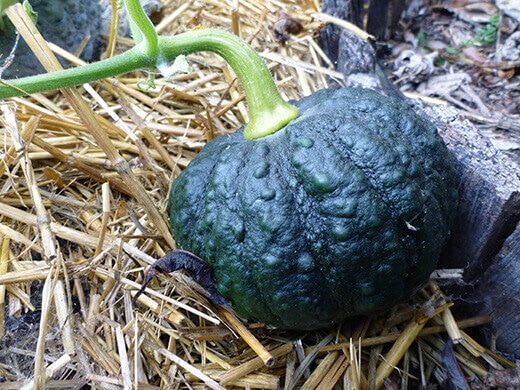
As it matures, the skin slowly turns dull with hints of yellow…
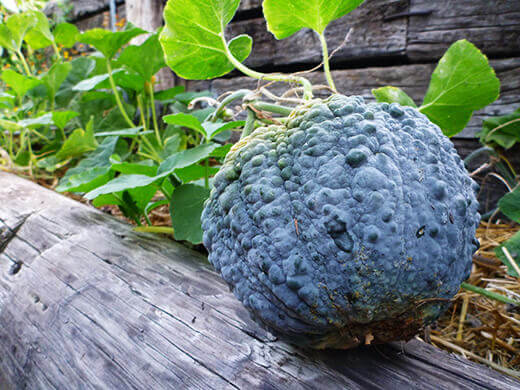
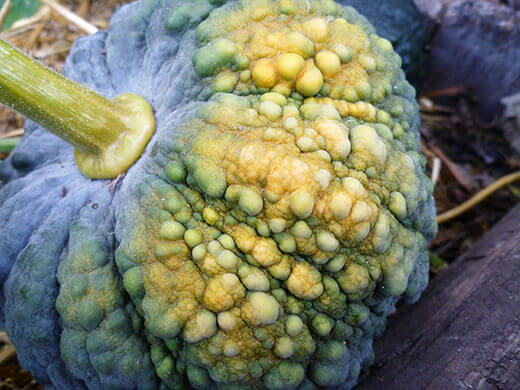
Then it takes on a rather strange and moldy appearance — in fact, I almost thought at first that all my plants had gone mildewy! But this is a natural process of toughening up the squash for storage, and once the skin has turned a grayish hue, it can be harvested and kept in a cool, dark larder (does anyone have one of those anymore?) for around six months.
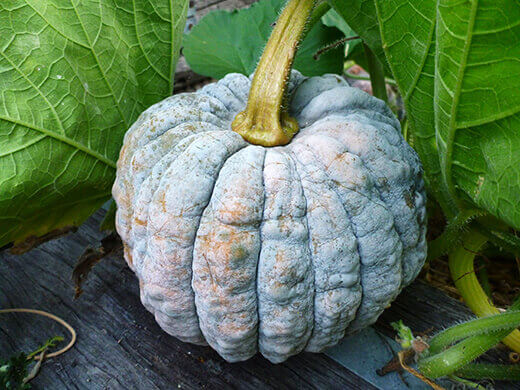
If you can wait another few weeks for harvest — as the skin transforms again into patches of orange — it will keep even longer. In storage, the squash will eventually settle into a tan or light brown color.
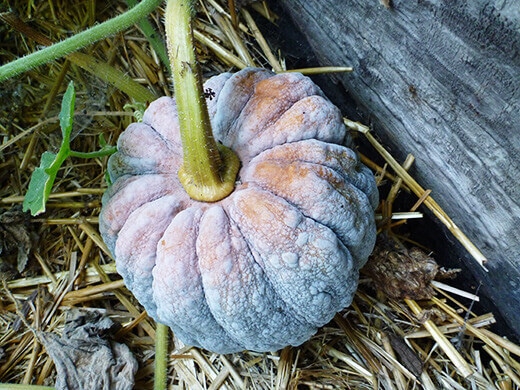
Black Futsu is a small squash variety, ranging from the size of a grapefruit to about three times that size. On the smaller end, it makes a good full lunch for one; on the larger end, it will feed up to four folks as a side dish.
Once you cut it open, you’ll find bright orange flesh with a flavor crossed between a pumpkin and a chestnut — sweet, buttery, and slightly nutty. Unlike the thick skins on many other winter squash, the relatively thin skin on Black Futsu remains edible.
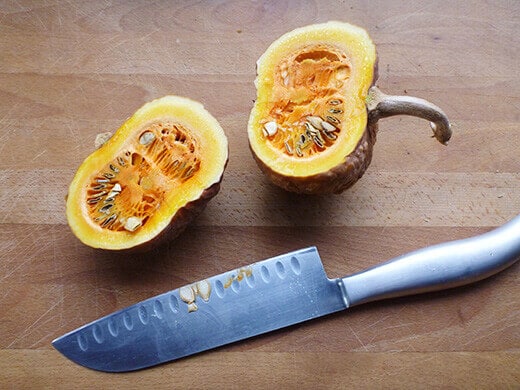
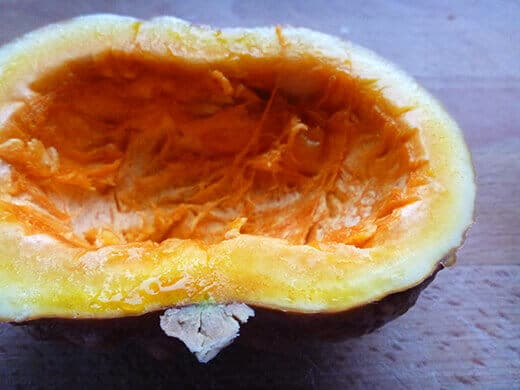
I like to slice the squash in half (especially the smaller ones) and roast with a little olive oil, salt and pepper until the flesh becomes soft and the skin becomes crisp. If I want to get really fancy, I’ll stuff the halves with a sprinkling of bacon and cheese (and whatever I find in the fridge).
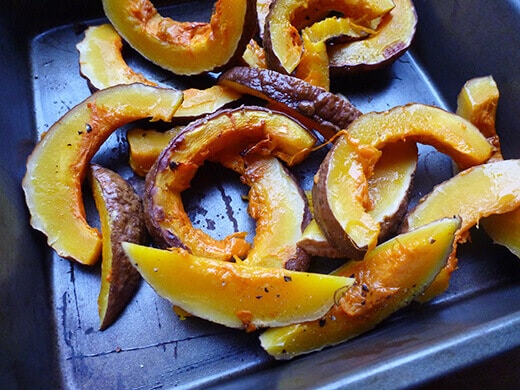
For larger squash, you can slice them into 1/2-inch or 1-inch wedges, toss with your favorite oil and spices, and roast at 425°F for about 30 minutes. These roasted slices actually come out tasting like sweet potato fries! So. Delicious.
I have five Black Futsus squirreled away for winter, and can’t wait to try a few new recipes in the coming months!





Can’t we just dry the seeds we scoop out and plant those instead of buy them? I’m always getting squash plant volunteers from my compost.
Thanks
Yes you absolutely can! (Especially if you’re saving seeds from your own open-pollinated squash.)
I love this squash because it’s homely in the outside and so dense, sweet and creamy on the inside. I think it needs some marketing TLC because I’m sure most people think it’s an ornamental or it’s moldy. I roasted some today to make soup but I just want to eat it as is.
I grew them for the first time this year. The terrible weather pretty much wiped out 3 other varieties. The Futsu kept going, one hill produced 18 pumpkins. Looking forward to trying a soup recipe I found.
what’s the soup recipe?
I am growing this for the first time and goodness are they taking a long time. It’s a long story but I accidentally harvested one too soon. Still dark green. Can it be salvaged or is it a loss?
I have had good luck with the too early picks by leaving them on the deck in full sun. It took a couple weeks but they did fully ripen. Good luck
I like to cut the “lid” off and scoop the seeds out. Then stuff the squash with hamburger or sausage. Put the lid back on with a meat thermometer and bake them on the grill till the meat is done. Pig out!!
So glad to have found your post! Had just checked my futsu that are growing in lingerie bags to prevent animals from eating them, and was dismayed to see that it had started bumpy, ugly, and yellow orange color! Was so afraid I had let it ripen too long or diseased! Whew!
We just bought a very old house in Townsend,GA. We noticed this exact squash like vegetables. It looks exactly like your pictures but it some how has grown up a pole in our backyard. However when we cut it open there are no seeds
Perhaps it was too young when you harvested it?
Black Futsu squashes are my new ‘must grow’ – they aren’t easy to find seeds for over here. Am very glad Baker Creek and Bobby’s Seeds ship to the UK. Are you trying any new varieties in 2015?
I have a few new varieties of lettuce, carrots, beets, and radishes that I’m trying this season… but I know that as soon as I go through the new Baker Creek catalog, I’ll be adding a lot more to my list for next year!
So, after roasting those slices skin & all, you then eat the whole thing? I intend to try growing some Futsu next year!
Yes! They are delicious.
Fascinating!
You can eat the skin on a kuri squash as well.
Thanks so much for the pics this is my first year growing black futsu. now a know what to do with it, glad it keeps well as I seem to have loads of the fruit.
I took your advice last year and grew zucchini rampicante. I loved it.
Now I google Black Futsu and found your blog again! Did you have any issues with squash borers attacking your plants? I read that they are the moschata variety . I grew blue hubbards, cucurbit maxima, but my plants were all attacked by borers and most died.
I haven’t had any problems with pests. I grew Blue Hubbards last summer and they were fine too. My only issue (with all my squash) is powdery mildew, which is quite common out here on the coast.
I am so jealous. The borers might as well be inch long woodchucks . Went right through the hubbards eating the plant the from insides. I have to get some cucurbit moscata plants to avoid the damn borers. Thanks for your input.
Try to attract more ground beetles and parasitic wasps into your garden by planting beneficials; they feed on squash borer larvae. You can also interplant beneficials with your squash. Every time I dig over an old bed, I always see lots of ground beetles.
i just planted this in my school garden in Hawaii!! i cant wait to watch it grow through this process and teach my students about what is happening
How fun for you and your students!
Just found your blog a few days ago and LOVE it! Today’s pictures of the Black Futsu were so beautiful! So much so that I immediately got on the Baker’s site and ordered a pack of seeds!! We are new to gardening and that looked like something wonderful to try.
We also have chickens for the first time ever and I loved the pics of your tikki coop. Kimora is sooo pretty. We are getting 2 Bards and have 3 Buffs right now. I told my husband about how you put the veggies in the wire suet basket—he went right out, bought one, and now our lovely girls are pecking away at it. It keeps them entertained because it spins around so much.
Looking forward to reading your blog each week. Very inspiring!
Thanks Lisa!
I’m almost coming up on a year since I’ve had my hens, they are a daily source of entertainment around here! So glad the suet cage works for your flock too! Another tip: I’ll sometimes hang a head of cabbage (or lettuce, kale, etc.) in the coop from its stem. It’s like an instant chicken pinata. 🙂
I’m definitely interested in branching out next year with winter squash. We had a very hectic summer with moving and were unable to really handle our plots at our community garden so all we got were spaghetti squash early on in June. Will have to check this variety out next spring.
I think you’ll really enjoy it! I grew a couple different winter squash but this variety was my favorite flavor.
I want to try spaghetti squash next year!
I don’t think it will win a beauty contest …
Really? I think all the bumps are beautiful. I have a fondness for warty squash: http://gardenbetty.com/2011/10/warts-and-wattles-patisson-strie-squash/